Hello world, did you know how many actualy tribe in Indonesia? Well, you can see bellow.
A
Acehnese in Aceh: Aceh Besar district
Alas tribes in Southeast Aceh district
Alor tribes in NTT: Alor regency
Ambonese In the city of Ambon
Ampana tribes in Central Sulawesi
Anak Dalam tribe in Jambi
Aneuk Jamee tribe in South Aceh district, West Aceh
district
Arab -Indonesia tribes
Aru Tribes in Maluku: Aru Islands
Asmat in Papua
Abung tribe in Lampung
B
Bali tribe in Bali consist of:
Bali Tribe Majapahit in most
island of Bali
Karangasem Tribes in Bali Aga
and Kintamani
Balantak tribes in Central Sulawesi
Banggai in Central Sulawesi: Banggai Islands
Baduy in Banten
Batik is historically derived from ancestors, known
since the seventeenth century, written and painted on palm leaves. At
the moment motif batik pattern is still dominated by forms of animals
and plants. But in its development history of batik have evolved, from
painting motifs of animals and plants gradually turn to the abstract
patterns that resemble a cloud, temple reliefs, wayang beber and so
forth. Furthermore, through the merger of the painting with the art of
decorating style clothing, batik art show as we know it today.
The
type and style of traditional batik quite so much, but the patterns and
variations in accordance with the philosophy and culture of each region
are very diverse. Indonesia's cultural treasures so rich nation has
been driving styles and types of batik tradisioanal with the
characteristics of specialty themselves.
The development of Batik in Indonesia

The
history of batik in Indonesia with regard to the development of the
Majapahit kingdom and the kingdom afterwards. In some records, the
development of batik is mostly done in times of Mataram kingdom, then in
the kingdom of Solo and Yogyakarta.
Art of batik is an art
image on the fabric for clothing that was one of the family culture of
Indonesian kings of old. Batik initially worked in the palace alone are
limited and the results for the king's clothes and family and his
followers. Because many of the followers of the king who lived outside
the palace, the art of batik was brought by them out palace and place of
each work.
In the development of this batik art gradually
imitated by the people nearest and subsequently expanded into the work
of women in the
Indian
civilization had a profound impact on Indonesia, especially in Java and
Sumatra. During this period the Mataram kingdom left an imprint on
architecture in Java. For a millenium, Javanese aristocrats, courtiers,
literati, and men of religion had been studying and adapting the ways of
Indian civilization.
Buddhism and Hinduism eventually blended with the native
Javanese animism to form unique combinations of structures and carvings
with significant meanings. Temple architecture in Central Java, like
the Dieng Plateau, Borobudur, and Prambanan, is testimony to the great
civilization that flourished as a result of Indian influence.
In the monumental architecture of the Hindu-Javanese society is a
conception that the terrestrial order mirrors and embodies the
celestial. The king is the sacred embodiment of the totality of the
state, just as the king’s palace is a microcosmic copy of the microcosm.
- Javanese Court Dance
- Sundays from 11.00 am – noon in Sri Manganti Hall & Thursdays fom 10.00 am - noon, Performing classical Court Dance.
- For more information, see Javanese Traditional Dance Classical Court Dance – Karaton of Yogyakarta.
- Exercise at the same time in Ksatrian
- Javanese Gamelan Music
Mondays and Tuesdays
From 10.00 – noon in Sri Manganti Hall,
- Wayang Leather Puppetry
- Wednesdays from 09.30 am – 12.30 am, Thengul puppet
- Saturdays 09.30 am - 12.00 am, leather puppet
Abbreviated performance in Sri Manganti hall
Visitors shall go inside the Karaton through Jalan Rotowijayan (West of Karaton) and Keben.
Wayang is a Javanese word for particular kinds of theatre (literally "theatre" or sometimes "puppet"). When the term is used to refer to kinds of puppet theatre, sometimes the puppet itself is referred to as
wayang. Performances of shadow puppet theatre are accompanied by
gamelan in Java, and by
gender wayang in Bali.
UNESCO designated
Wayang Kulit, a shadow puppet theatre and the best known of the
Indonesian wayang, as a
Masterpiece of Oral and Intangible Heritage of Humanity on 7 November 2003. In return for the acknowledgment, UNESCO required Indonesians to preserve their heritage.
The Traditional games this one is already familiar to the javanese children, because it will almost certainly be found easily in many
places in the remote rural and urban, in the past. Stilts
included children's games, because this game has been around since at
least once before the independence of the Republic of Indonesia, during
the Netherlands colonization. It was as recorded in Baoesastra (Dictionary) Java WJS article Poerwadarminto 1939 issue page 113, mentioned the "egrang-egrangan" because this game using a tool called "egrang"(silts). While the stilts themselves given meaning bamboo or wood to be ground (for legs) to move freely walking legs.
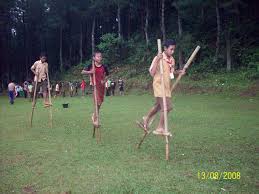 Stilts
are made simply by using two bamboo sticks (more frequent use of this
material
Stilts
are made simply by using two bamboo sticks (more frequent use of this
material
The Indonesian President, Susilo Bambang Yudhoyono (L), and the author wearing batik.
2 October 2009 / DIPO ALAM*,
With the spirit of
UNESCO's 2003 Convention for the Safeguarding of the Intangible Cultural
Heritage in mind, and after a long and complex process, batik will
finally be listed by the world cultural body as Indonesian cultural
heritage.
Actually this blog is less still so, what do you think about content that must to be add? Please give your comments. Thank you for visiting.